The earliest recorded Jewish presence in Greece was in
the port city of Salonika. Brought to the city from Alexandria in Egypt by
Alexander the Great’s brother-in-law, Kasandros, because of their expertise in
maritime trade, Hellenized Jews established their community and built their
first synagogue, Etz Hayyim. St. Paul preached here in the first century but was
rejected by the Jews of the city.
At the beginning of the twentieth
century there were over 80,000 Jews living in Salonika, more than half the
population of the city. The Jews controlled the economy of the city and had
established 40 synagogues. There was no one Jewish neighborhood. So large were
their numbers that they lived throughout the city. In 1917 there was a
devastating fire that destroyed most of the synagogues. They would be rebuilt
but the economic hardships and the uncertain climate of the now “Greek” city
of Salonika, which had become part of Modern Greece in 1912, caused many of the
Jews to immigrate, most to the United States.
At the dawning of WWII there were
56,000 Jews in the city. On April 9, 1941 the Germans took over the city. About
10,000 Jews were able to flee to safer havens before the mass deportations of
1943. From March to July of 1943, over 46,000 Jews were deported to Auschwitz-Birkenau.
Only 1,200 would survive. The Jewish cemetery, with over 300,000 tombstones, the
earliest dating back to the 15th century, was destroyed by the
Germans. Of the 36 synagogues, only Monasteriton would survive.
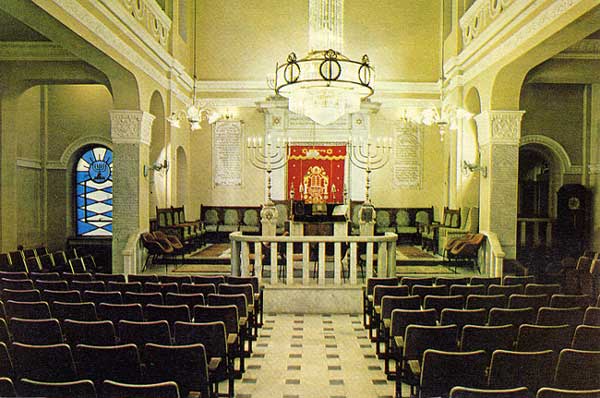
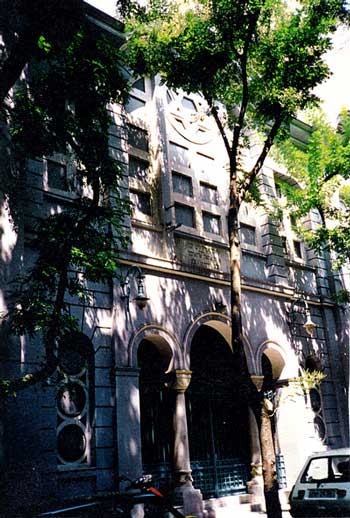
There are now 1,200 Jews living in Salonika. There are two functioning synagogues and a chapel in the Saul Modiano Senior Home. There is a new Jewish Museum that traces the proud history of Salonikian Jewry.
Monasteriton Synagogue--
The
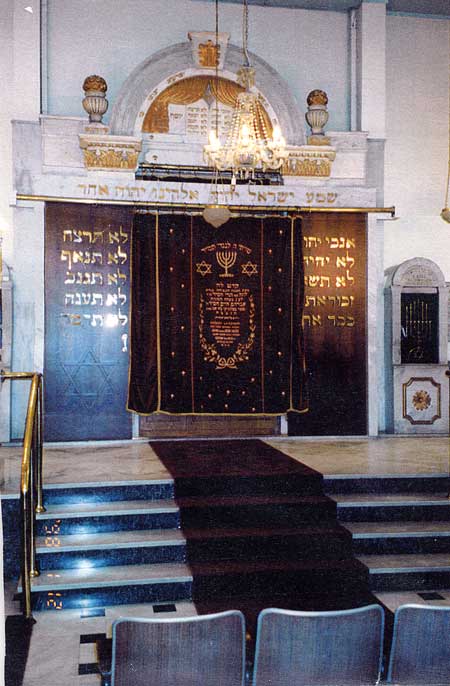
Yad Lezikaron Synagogue-- The Yad Lezikaron Synagogue was constructed in 1984 out of the remains of former synagogues in Salonika. Many of the plaques from former synagogues are in the walls of the interior sanctuary, as are some of the ner tamids (lamps). The synagogue is simply constructed within a commercial building at 26 Vas. Herakleios Street. The layout is traditionally Sephardic, with the Tevah in the center and the Echal on the far eastern wall. The picture below shows the Echal.
The
Jewish Community of Thessaloniki. The Jewish
Community of Thessaloniki,
Holocaust
in Salonika: Eye Witness Accounts,translated
by Isaac
Amariglio,
Erika Kounio. From Thessaloniki to Auschwitz and
Back 1926-1996,
Fromer, Rebecca Camhi.
The Holocaust Odyssey of Daniel
The House by the Sea,
Mercury House, 1998.
Molho, Rene. They Say Diamonds Don't Burn: The Holocaust
Copyright © 2002 Edward Victor