Jewish settlement in Minsk began in the 15th century. During the 19th century, it was one of the largest and most important Jewish communities in Russia. By 1897, the Jewish population was over 47,000 (52% of the total population). After the Communist takeover, Jewish communal and religious institutions were replaced by Jewish cultural organizations based on Communist ideology. At the outbreak of the German-Soviet war (June, 1941), the Jewish population of Minsk was estimated at about 90,000. The Germans captured the town on June 28, 1941, and a Judenrat was established in July. By August, a ghetto housing about 100,000 Jews was created. This ghetto was one of the few that had an active underground resistance. As a result of this underground, it is estimated that about 10,000 Jews were able to escape the ghetto and join partisan groups. In October, 1943, the ghetto was liquidated. In all, about 90,000-100,000 ghetto residents, including many who had been deported from Germany, were murdered by the Germans.
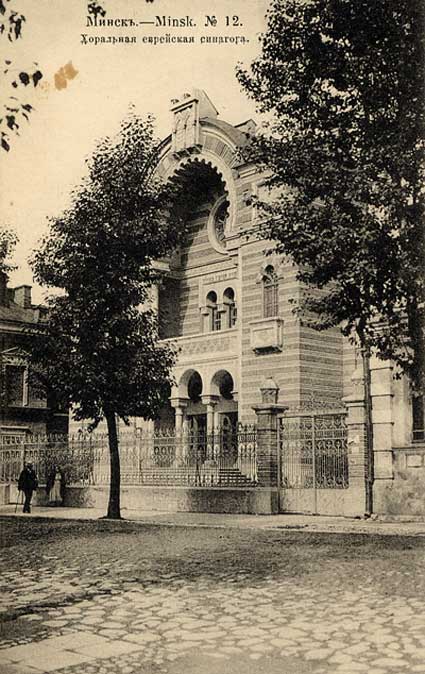
The below postcard printed in 1915 depicts the main Minsk synagogue. After the Soviet revolution, the synagogue was ultimately converted to a Jewish State Theater.
Spector, The Encyclopedia of Jewish Life Before and During the Holocaust, P. 826-29
Encyclopedia Judaica, CD-Rom Edition, Keter Publishing
Http://ghetto.actiweb.com/minskghetto.html
Copyright ©2002 Edward Victor