Between 1934 and 1940, the Japanese government devised a secret plan to attract Jewish capital and skilled labor by offering refuge to to European Jews in Manchukuo (Manchuria), the newly conquered north China colony. The aim of this plan was help build the economy and infrastructure of Manchukuo. This plan was given the name "Fugu" after the Japanese delicacy, the puffer fish, whose poison could kill if not properly cooked. The Japanese believed that the Jews possessed extraordinary economic power and skills, particularly American Jews. These beliefs were based, in part, on extreme anti-Semitic books, such as the Protocols of the Elders of Zion, which claimed that Jews were the decisive international financial and political power, especially in western countries. The Jewish communities established under the plan would be funded by Jewish organizations. Although the plan was never implemented in any significant manner, several thousand Jews were rescued from certain death under the Nazis.
In 1897, Russia, after invading Manchuria, was granted a concession to build the China Eastern railway, and Harbin became the administrative center for the project. Russia was also anxious settle the region. In this connection, it offered Jews freedom of religion and business rights if they settled in the area. By the mid-1920s, there were over 13,000 Russian Jews living in Harbin and the surrounding area. This relative "paradise" came to a screeching halt with the Japanese occupation of Manchuria. Jewish businesses were appropriated, and Jews were subject to extortion, kidnappings, and other forms of terror. These acts lead to a mass flight from the city, and by the mid-thirties, about 70% of the Jews fled. The supporters of the Fugu Plan realized that this flight had to stop in order make the plan work. These efforts helped stem the departures. With the start of the war and alliance with the Nazis, many Jews attempted to leave. By 1951, nearly all the Jews in Harbin had emigrated, mostly to Israel, but also the United States and Australia.
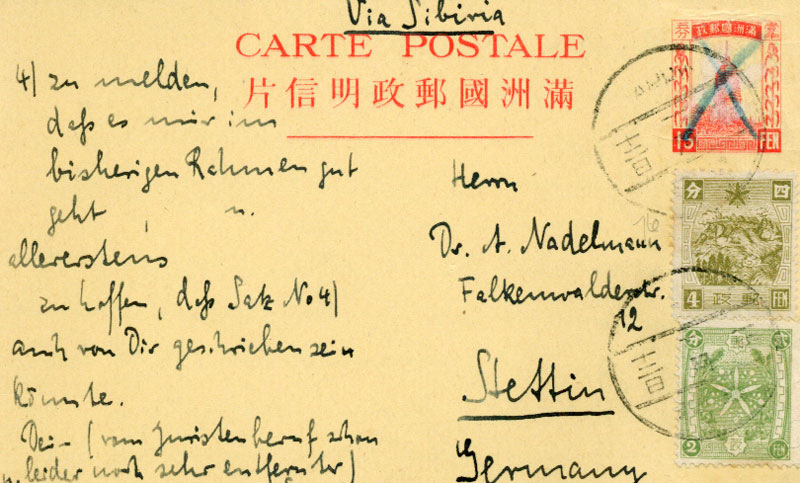
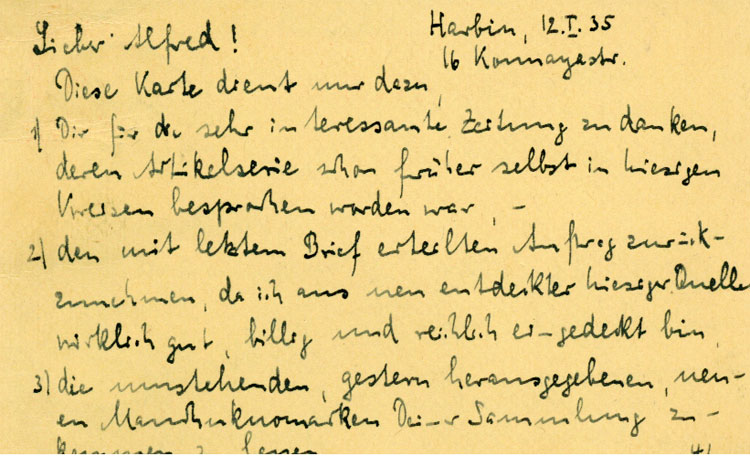
Below are thumbnails of the front and back of two postcards pertaining to the Jewish community in Harbin. The first postcard, postmarked January 12, 1935, was sent from Harbin by Ernst Cohn, addressed to Dr. Alfred Nadelmann, a pharmacist in Stettin, Germany. The translation of the postcard is as follows:
"Dear Alfred,
This card only serves the purpose, 1) to thank you for the interesting newspaper containing the series of articles which had already discussed within our local groups, 2) to take back the expressed inquiry in previous letter, as I was able to obtain some newly discovered source satisfactory, inexpensive and plentiful, 3) to contribute to your collection the new Manchukou stamps issued yesterday, 4) to report that under present circumstances I am well-- which I hope is also the case with you.
Your, regretfully still far removed from the legal profession."
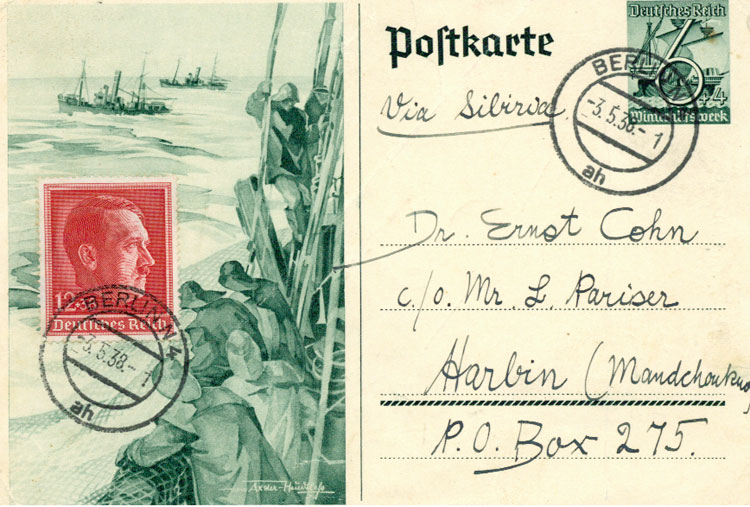
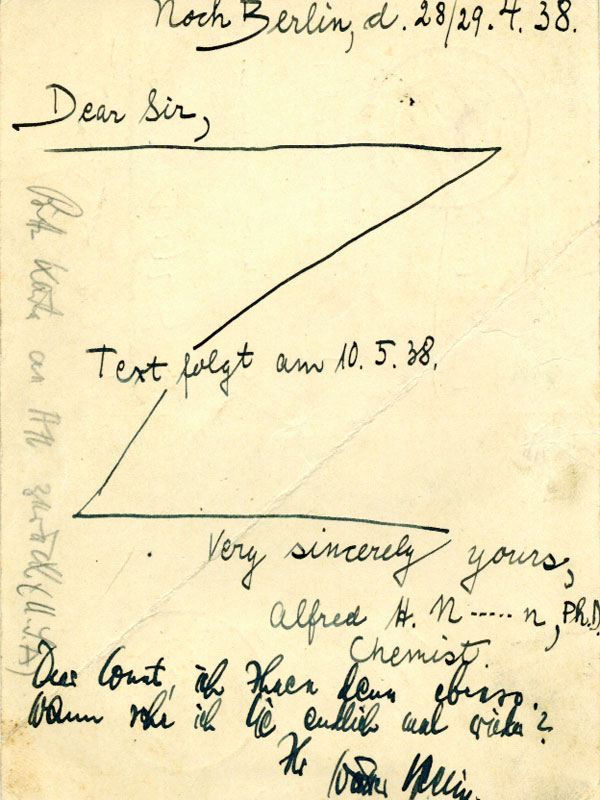
The second postcard is from Nadelmann to Cohn, postmarked Berlin, May 3, 1938, with an unusual message in English that was probably some form of code. Henry Schwab, in the article cited below, speculates that the imagery of the postcard conveys the message that Nadelmann is leaving Germany on May 10, 1938 for the United States. Please click on the thumbnail to see the full image, and then click your back key or "Postcards" in the left frame to return.
Tokayer and Swartz, The Fugu Plan, (Paddington Press 1979)
http://en.wikipedia.org/wiki/Fugu_Plan
Gutman, Encyclopedia of the Holocaust, Macmillan Publishing Company (1990), P.579-82
Henry Schwab, Flight From Nazi Germany-- Harbin, Manchukuo, The Israel Philatelist (August, 2004) P. 131
Ghetto

Home Page
Copyright © 2006 Edward Victor