Although Jews may have lived in Florence prior to 1437, it was not until that year that the Jewish community was established when some Jewish financiers were invited to make bank loans. By and large, the Jews were better off in Florence than many other cities in Europe, primarily as a result of the protection of the aristocracy, particularly the Medici family. Beginning in 1571, the ghetto system was strictly enforced. Emancipation began with the entry of the Napoleonic army in 1799. Upon the incorporation of Tuscany in to the Kingdom of Sardinia in 1859, Jews received full rights as citizens. In 1931, over 2,700 Jews lived in the community. During the German occupation in 1943-44, 243 Jews were deported, of whom 13 returned. After the war, there were about 1,600 Jews left in Florence. As of 1970, the Jewish population was about 1,250.
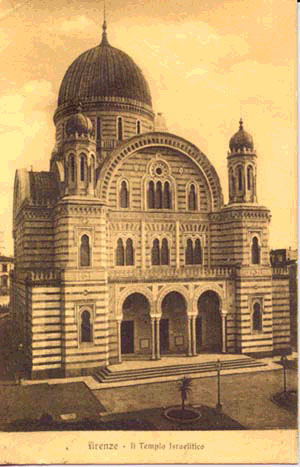
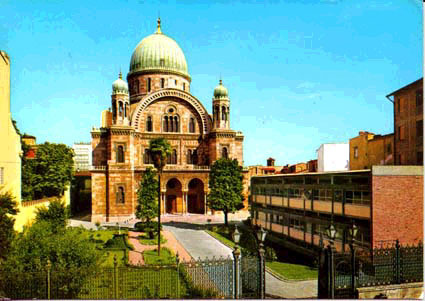
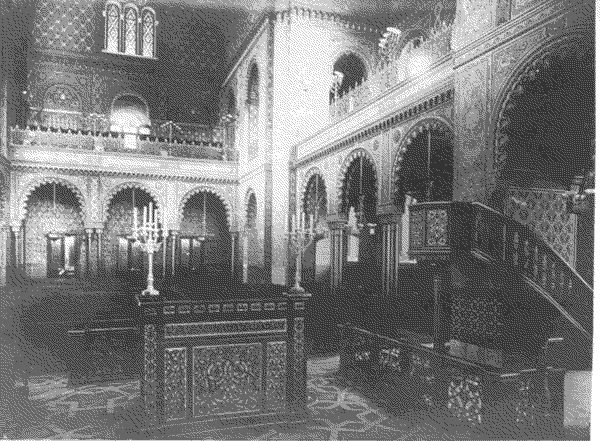
When Florence became the capital of Italy (1864-70), the Jewish community was eager to build a grand synagogue. The funds for the project came from a bequest by Daniele Levi. The designers were three Florentine architects, Mariano Falcini, Vincente Micheli, and Marco Treves. Work began in 1874, and the synagogue was dedicated in 1882. The synagogue was damaged during the war and by the flood of 1966. The postcards below depict the synagogue and its interior.
Encyclopedia Judaica, CD-Rom Edition, Keter Publishing
Carole Herselle Krinsky, Synagogues of Europe, P.348-51
Copyright © 1998-99 Edward Victor