Cochin is a city and former state off the Malabar Coast in southwest India. The Jews in the area were divided into three groups: (1) "White Jews"- a mixture of Jewish exiles from Cranganore, Spain, Aleppo, Holland and Germany who have white coloring and follow the Sephardi rites; (2) "Black Jews"- have the same coloring as other Indians and separate synagogues from the White Jews; and (3) "Meshuhrarim"- former slaves and their offspring.
The earliest evidence of the settlement of Jews on the Malabar Coast is found on two copper plates in the possession of the congregation of the White Jews. On these plates are engraved ancient language privileges granted to a Joseph Rabban by the Hindu ruler of Malabar. The text of these plates has been dated between 974 and 1020 AD.
Under the Portuguese rule of India (1502-1663), the Jews of Cochin could not have survived had it not been for the protection and liberty accorded them by the Rajah of Cochin, who welcomed new Jewish immigrants and granted then religious and cultural autonomy. He appointed a chief from among the Jews as their recognized spokesman and invested him with jurisdiction in all internal matters of communal organization.
During the Dutch period (1663-1795), the Jews achieved complete cultural autonomy and religious freedom. In 1686, the Jewish community in Amsterdam dispatched a delegation to Cochin to visit the Jewish community. The visitors made a considerable impact, and close contact between the Jews of Amsterdam and Cochin lasted though out the years of Dutch rule. Dutch rule also brought unparalleled prosperity to the Jews with their emergence as bankers, merchants and diplomatic leaders.
In 1948, the Jewish population in the area was about 2,500. By 1995, there were less than 100 Jews left. Most of the Jews who left settled in Israel.
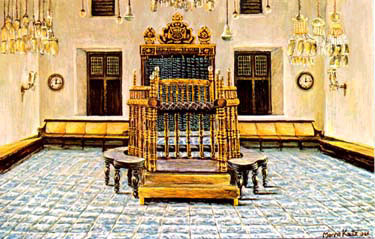
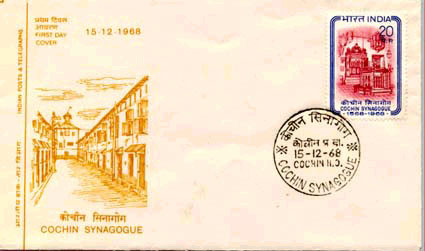
The only synagogue still in use in Cochin is the Paradesi ("Foreigners") Synagogue of the White Jews built in 1568. The land to build the Synagogue was given to the Jewish community by the Rajah of Cochin. In 1968, the Synagogue celebrated its 400th anniversary. In honor of the occasion, the Indian government issued a stamp depicting the interior of the Synagogue (Scott# 478). Below is the first day cover issued for the event. Also below is a picture postcard depicting the interior of the Synagogue.
Encyclopedia Judaica, CD-Rom Edition, Keter Publishing
Beth Hatefutsoth Communities Database
Copyright © 1998-99 Edward Victor