Prior to World War II, Budapest was one of the largest and best organized Jewish communities in the world. At the time of the outbreak of the war, there were about 200,000 Jews in Budapest. Until the German occupation in March, 1944, the Jewish community lived in relative comfort and security. After the German occupation, provincial Jews were systematically concentrated and deported. Under the Horthy regime, deportations of Jews were stopped, but in October, 1944, this regime fell and was replaced by a Nazi backed regime under the infamous Arrow Cross Party. Beginning in November, 1944, over 70,000 Jews were deported. At this time, many neutral diplomats (such as Raoul Wallenberg) exerted great efforts to rescue Budapest Jewry. Many Jews were provided with Schutzpasses (protective documents) which placed holders under diplomatic protection. Most of the deported Jews were sent on a death march to the Austrian border. Due to the approach of the Russian army, many of these marchers were saved. At the time the city was liberated on January 17, 1945, there were about 70,000 Jews left in the ghetto.
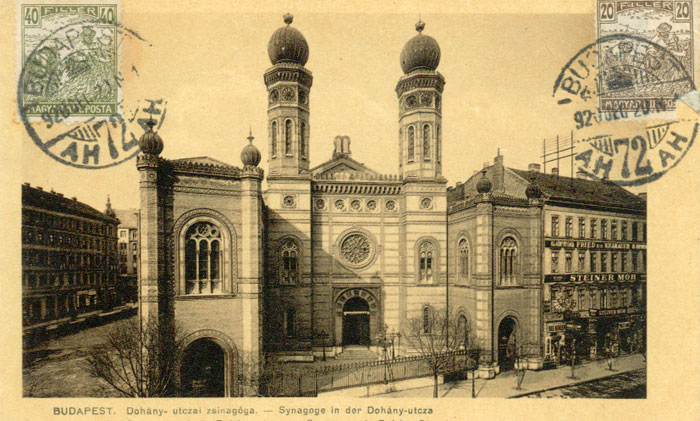
The synagogue depicted in the postcard below (postmarked 1920) is the Dohány Street synagogue. The first plans for the synagogue were made in 1848 by Jòzsef Hild. New plans were made in 1850 by Frigyes Feszl. Neither plan was implemented, and in 1853, a design competition was won by a Viennese architect, Ludwig von Förster. Construction was not completed until 1859. With its 3,000 seats, it was one of the most magnificent synagogues in Europe. Theodor Herzl lived next door to the synagogue and was bar mitzvahed there. A visit to the synagogue is a must for anyone visiting Budapest.
Spector, The Encyclopedia of Jewish Life Before and During the Holocaust (2001), P. 213-18
Carole Herselle Krinsky, Synagogues of Europe, P. 157-59
Copyright © 2008 Edward Victor